
A Museum in the Line of Fire
In 1956, the Natural History Museum operated at three locations in Budapest. The earth science departments and most of the exhibitions were housed in the National Museum; the General Directorate, the Central Library, the Department of Zoology, and the Department of Anthropology were located on Baross Street; and the Department of Botany and the botanical exhibition were housed in Vajdahunyad Castle in the City Park (Városliget). During the revolution, severe fires ravaged the first two buildings.
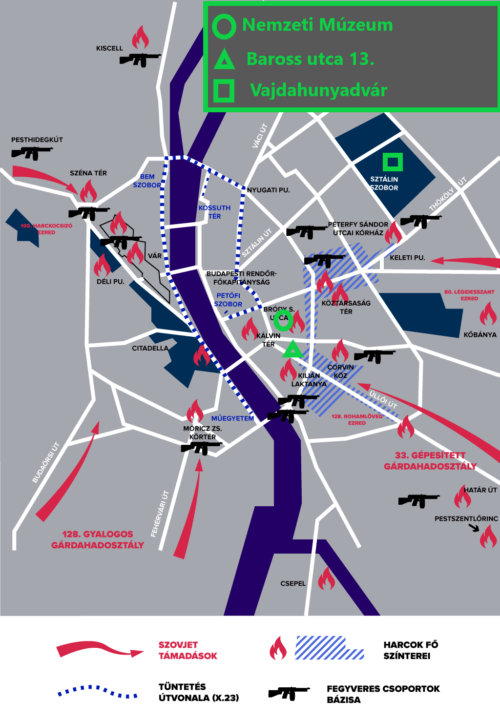
National Museum
Our institution – then officially known as Hungarian National Museum—Natural History Museum – shared the iconic building on Múzeum Boulevard with the HNM Museum of History and the National Széchényi Library.
On the night of October 23–24, 1956, the insurgents stormed the buildings of Hungarian Radio, located right next to the National Museum. Meanwhile, they broke into the museum and fired from there, first at the defenders of the Radio building complex then at the Soviet tanks arriving from Kálvin Square at dawn on the 24th. The tanks fired on several nearby buildings, and the museum was hit by at least seven tank shells.
At noon on October 24, 1956, firefighters, alerted by smoke billowing from the windows of the mineralogical department, arrived on the scene and extinguished the fire, but the Soviets then ordered them out of the building. Over the next day and a half, the fire — which had not been completely extinguished — flared up again several times. Firefighters were dispatched time and again, but their self-sacrificing efforts were hindered by the fighting and by Soviet troops, so the fires between the 24th and the 26th caused enormous damage. Further details can be found in the following panel and in the “Memento 1956” memorial display case located on the ground floor of this building.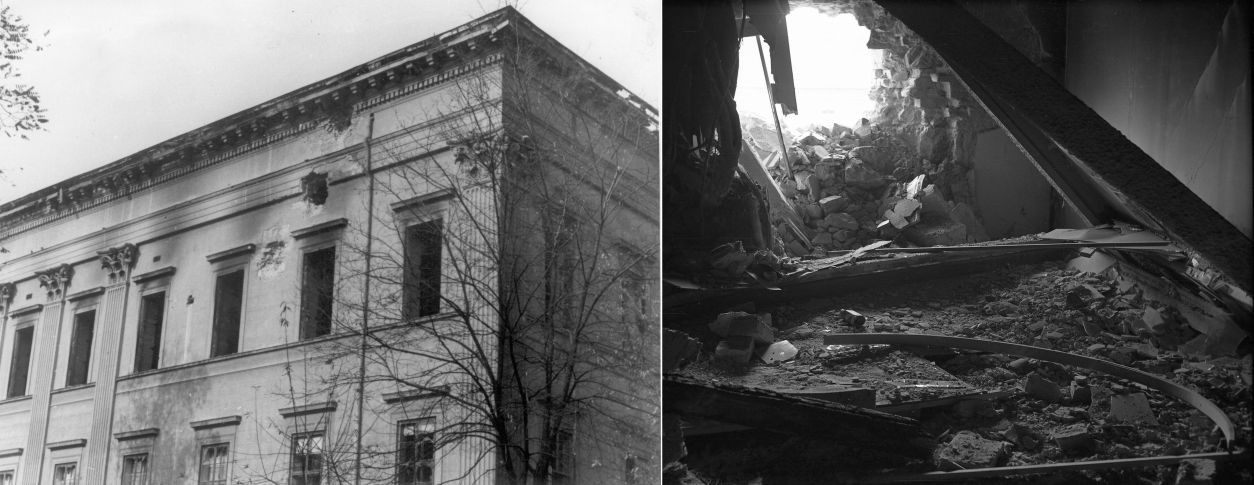
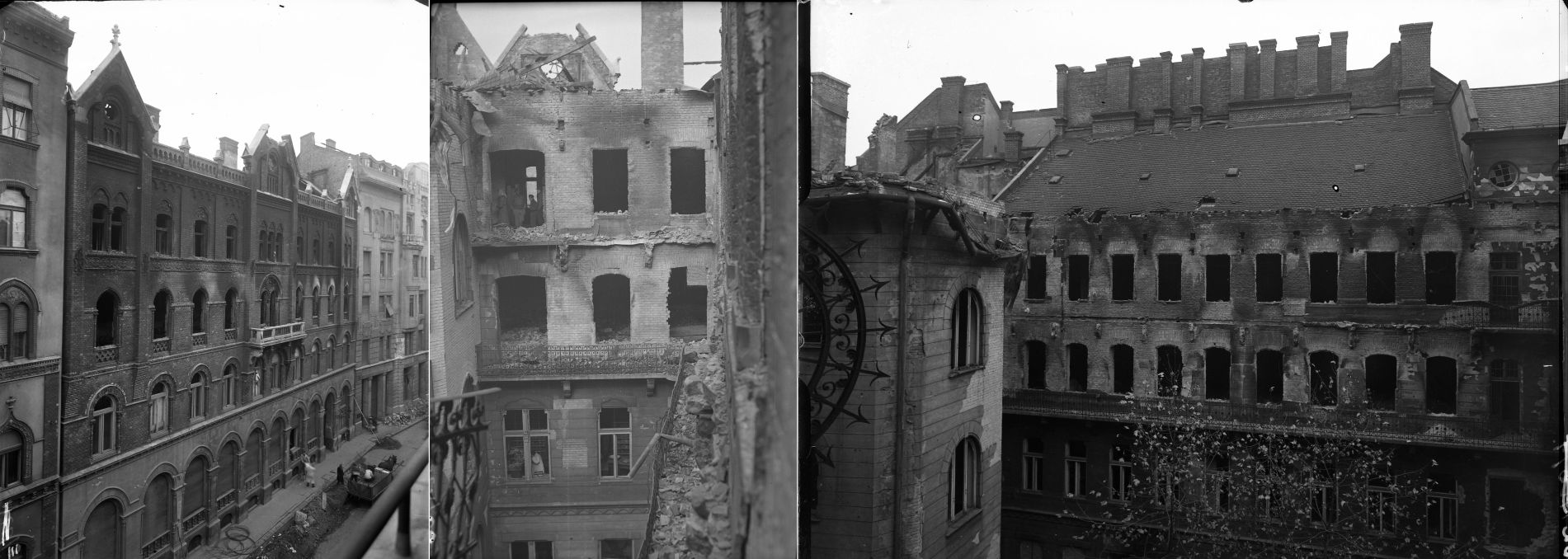
13 Baross Street
The building, purchased in 1926 and originally used as the headquarters of a land credit institution and as a residential building, was not damaged during the first Soviet intervention. However, on the afternoon of November 5, a shell struck the reptile and amphibian collection – preserved in alcohol – located on the top (third) floor because of the fire hazard it posed. The more than 20,000 litres of burning alcohol turned that section of the building into a sea of flames in a matter of moments. The caretaker of the building and his wife, along with a few museum staff members who had arrived in the meantime, worked with residents of the surrounding buildings to prevent the fire from spreading further until the firefighters arrived. Late that evening, the firefighters withdrew due to renewed gunfire, and they were only able to finally extinguish the flames—which had regained strength—after returning the following morning. Further details can be found on the third panel.
The Devastation Caused by Fires in the Earth Science Departments
The Department of Mineralogy and Petrology, located on the south side (facing Múzeum Street) of the second floor of the National Museum, was completely destroyed in the fires between October 24 and 26; only the objects in the display cases and their drawers on the west side (facing Múzeum Boulevard) remained intact. Approximately 80% of the 135,000 catalogued items were destroyed. On the night of the 25th–26th, the fire spread from this department to the Department of Geology and Palaeontology on the eastern side (facing Pollack Mihály Square) and also partially destroyed the collection rooms and workrooms of the latter department. Its collection contained 69,000 catalogued items, and the loss here was also estimated at 80%. The specialized libraries and collection inventories of the departments were also almost completely destroyed.
The Fate of the Africa exhibition
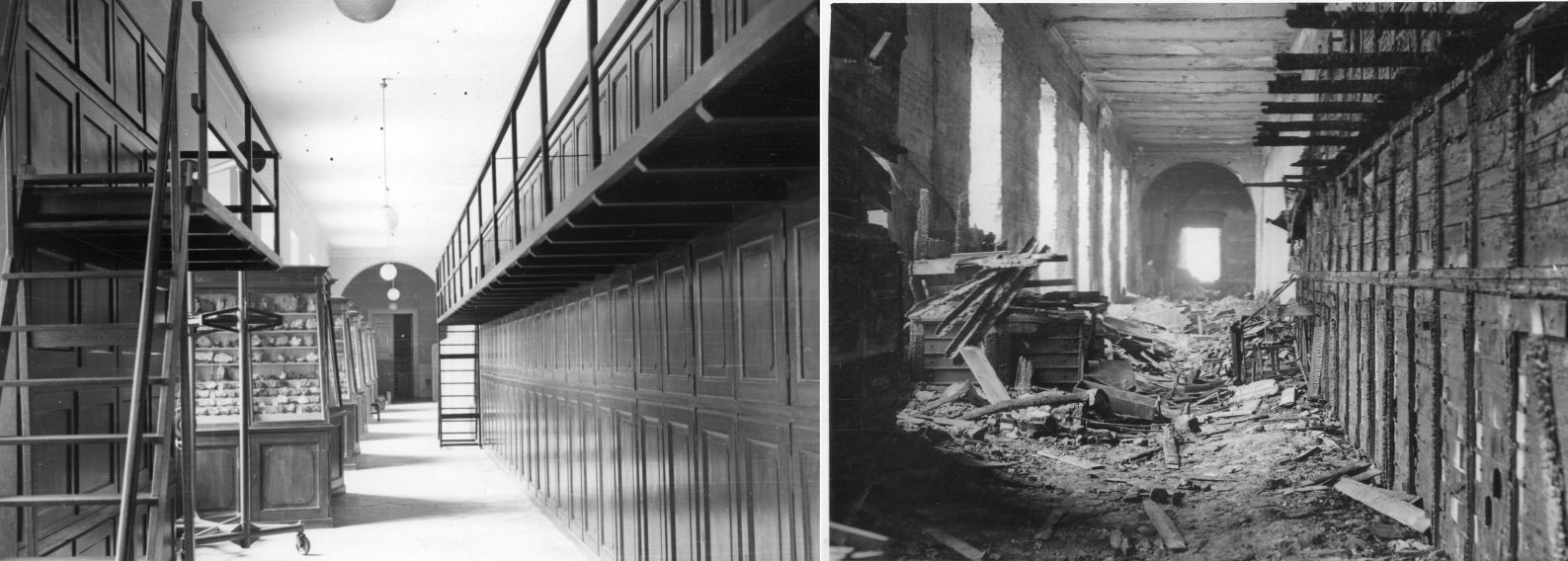
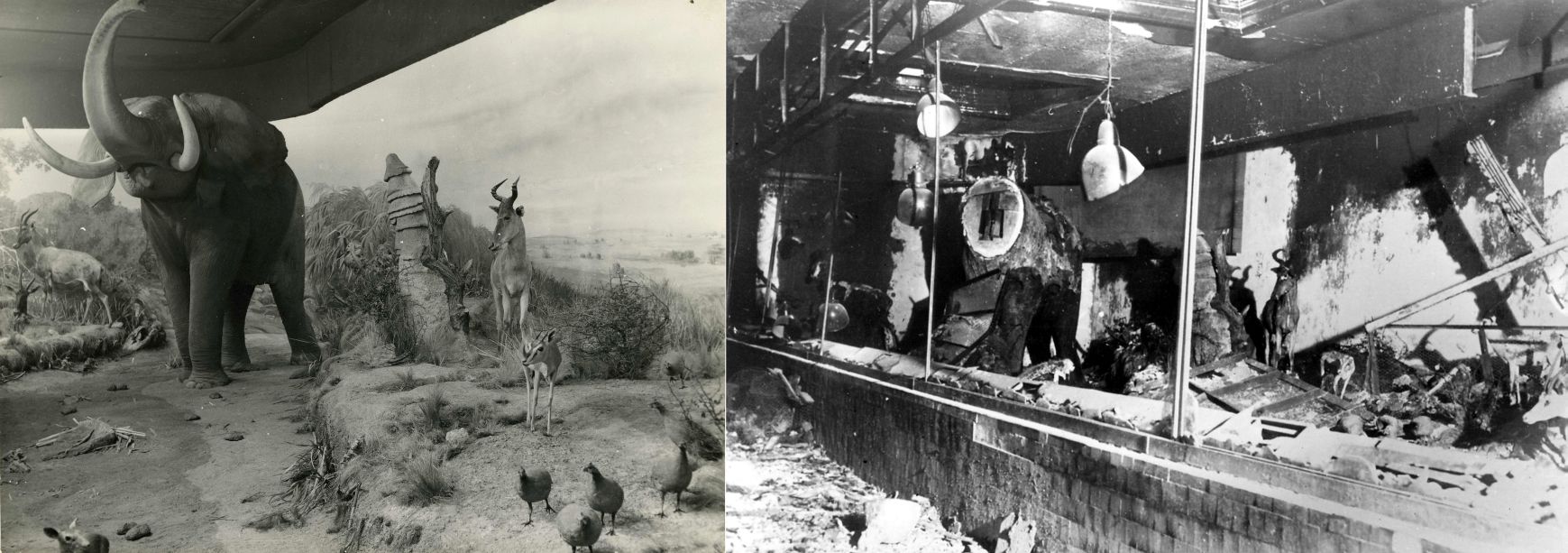
The famously beautiful Africa exhibition, which opened in its entirety in 1951, began with a long corridor (the “Antelope” room), lined with display cases on the right and (primarily antelope) trophies on the left. The corridor led into the “Crocodile” room, which got its nickname from the diorama in the centre, though there were also several smaller, diorama-style display cases along the walls. From there, visitors could access the two largest exhibition halls. The first, the “Lion” room, featured an eight-part diorama complex that visitors could walk around, as well as two wall-mounted diorama niches. The second, “Elephant” room was dominated by a large (nearly 7 meters deep and 20 meters long) diorama depicting the wildlife of the Ruwana Plains in Tanzania.
The fate of the Africa exhibition was influenced by several unfortunate factors. Since it was located on the third floor directly above the mineral collection, the fire from there spread to the two large exhibition halls, which were largely burned out, while the objects in the “Antelope” room were covered in soot. The “Crocodile” room, however, was destroyed by a tank shell. The palaeontology exhibition, located on the same floor (above the mineralogy exhibition), was fortunately spared.
Losses and new beginnings – the collections of the Baross Street building
In the building at 13 Baross Street, a significant part of the collections of the Department of Zoology and Department of Anthropology was damaged in a conflagration caused by artillery shells. The collections also suffered water damage due to firefighting efforts and a burst main water pipe. In addition to the destruction of collection libraries, equipment, and scientific manuscripts, the collections suffered the following losses:
|
Collection |
Destroyed |
Damaged |
|
“Protozoa collection” |
2,500 vials and 3,000 slides (entire collection) |
|
|
“Collection of Lower Invertebrate Animals” |
50,000 specimens (entire collection) |
|
|
“Hydrachnella Collection” |
4,000 vials and 1,350 slides (entire collection) |
|
|
“Orthopteriode and Neuropteroide Collection” |
60,000 specimens (almost entire collection) |
|
|
“Hemiptera – Homoptera Collection” |
minimum 10,000 specimens |
at least 30,000 specimens |
|
“Coleopterological Collection” |
two Curculionide boxes |
significant number of specimens |
|
“Lepidopterological Collection” |
2,500 specimens |
10,000 specimens |
|
“Diptera Collection” |
200,000 specimens (three-quarters of the collection) |
|
|
“Malacological Collection” |
500,000 specimens (entire collection) |
|
|
“Ichthyological Collection” |
15,000 specimens (entire collection) |
|
|
“Herpetological Collection” |
40,000 specimens preserved in alcohol, the 4,000-piece bone collection, the 100-piece frog-limb collection (entire collection), and 450 borrowed alpine newt specimens |
|
|
“Ornithological Collection” |
36,000 bird skins, 22,000 eggs and 2,300-piece bone collection (entire collection) |
|
|
“Mammalogical Collection” |
28 stuffed specimen (in the dioramas of the African Exhibition) and 192 specimens of the bone collection |
|
|
“Department of Anthropology” |
1299 skulls |
|
*Boros I. 1957: The tragedy of the Hungarian Natural History Museum. – Annales historico-naturales Musei nationalis hungarici 8: 491–505. p.
